When employees have to repeat the research behind an AI answer, the problem does not necessarily come from the AI. The company information it relies on may be out of date or difficult to access. Staff then have to return to the original files to find what the answer missed and rewrite it before passing it on. That extra effort leaves colleagues waiting for an answer they can use to make a decision.
Understanding why enterprise AI fails starts with that gap between getting an answer from AI and having an answer your team can trust and use. For a company using private AI, the next investment should address the source of that gap while preserving the data controls the business requires.
Why enterprise AI fails even with a strong model
Enterprise AI fails when a capable model lacks the right evidence or sits inside a process that staff struggle to use. The model is one part of the service your team relies on.
Even with a stronger model, you still need up-to-date company records. An old policy gives the assistant outdated guidance, while a missing passage leaves out information needed to answer the question. Improving the model alone does not resolve either problem.
Each cause calls for a different repair owner. The document owner updates an old policy, while engineers find out why the AI missed a passage. If the model misreads the right evidence, a change to the model or its input (the prompt) becomes a relevant test.
Private AI processes company data in a controlled environment, but that alone does not make its answers accurate. Your controls govern who has access and how the data is used. Testing the assistant against staff questions addresses a different issue: whether it gives answers supported by the right company information.
How employee habits affect enterprise AI results
Employee habits affect whether AI answers are ready for others to use. Staff supply the context an answer depends on and decide what to pass on. Managers influence those habits through the standards they set and the time they allow for review.
Review AI answers before passing them on

Reviewing an AI answer before submission gives its author a chance to catch unsupported claims. Without that review, the recipient has to find the source and decide which parts of the draft to keep.
In September 2025, BetterUp Labs and Stanford Social Media Lab surveyed 1,150 full-time US desk workers online. Of those respondents, 40% said they had received AI-generated content that looked polished but lacked substance in the month leading up to the survey.
Start by checking whether the draft answers the question it was written to address. A policy summary, for example, needs to include any exception that applies to the request. Check that each citation supports the claim it accompanies and that the source is current enough to guide the decision.
How closely you review the draft depends on the consequences of getting it wrong. Internal brainstorming needs a different level of scrutiny from advice sent to a customer. When a message commits your company to a decision, follow the existing approval process, even if AI prepared the first draft.
If a claim remains uncertain, explain it in a note alongside the draft before passing it on. Make clear what you have checked and what still needs confirmation, so the next reviewer knows where their expertise is needed.
Keep responsibility with the person using AI

The person submitting AI-assisted content remains responsible for it within their role. They should understand their advice well enough to explain the reasoning and point to the facts behind it. Otherwise, the next reader has to reconstruct the recommendation and find its supporting evidence.
Responsibility for a draft does not grant authority to approve a business decision. An employee preparing a report owns its factual support, while a manager with the right authority decides whether to act on it.
If your system uses agentic AI to take actions, such as sending emails or updating records, it needs to follow your company’s approval rules. Any action that normally requires human approval should still require it when AI handles the work
Managers also have to allow time for the review they expect. A demand for fast drafts and careful fact review creates tension when the schedule leaves no time for both. Staff need a way to raise doubts or seek help before passing the document on.
Set clear standards for AI-assisted tasks

Clear standards tell employees when to use AI and what a finished document must contain. Those standards also set how much the author must verify before submission.
Training gives staff a place to practice applying those standards to daily requests. Exercises cover the context an answer depends on and claims that lack evidence. Staff also learn who handles a question beyond their authority or knowledge.
Recognize employees for the quality of the reports they deliver. This encourages them to improve how they assess AI answers as well as how they write prompts. Usage counts show how often staff turn to AI, but the accuracy of the finished report is a better measure of whether it helped.
To understand those usage patterns, ask employees about their experience. Low usage could reflect reluctance to change, difficulty using the system, or doubts about its answers. Staff feedback helps identify which issue needs attention.
How to find the cause of wrong AI answers
There are many reasons behind wrong AI answers. Finding where the answer went wrong helps your team choose the right fix.
Start with a question an expert knows how to answer. If the correct answer is missing from company records, the first repair is to add the missing information to those records. Changing the model leaves that gap in place.
Search becomes the focus when the answer exists, but the application fails to find it. Retrieval-augmented generation, or RAG, supplies the model with material found through search. RAG challenges include finding the right passage without losing a condition that changes its meaning.
The model is the next focus when search finds enough evidence, but the answer still gets it wrong. RAG hallucinations include invented details or claims that the retrieved evidence does not support.
Your team needs the question, retrieved passages, and answer to repeat the test after a change. The failed case shows whether the reported error remains, while earlier successful cases test for a loss of accuracy.
Check AI speed and integration with business systems
AI speed and software systems integration determine how easily staff use an accurate answer. Long waits interrupt a request, while manual transfers add effort after the response appears.
Response time includes the search and any calls to connected services. Execution records help engineers see which part caused the delay. For agent-based assistants, AI agent monitoring also traces the actions the software requests. A slow search calls for a different repair from slow answer generation, so the total wait alone is not enough to choose a fix.
Response-time tests need to reflect normal demand. A fast demo with one person says little about response times when colleagues use the service at once. Testing that load exposes delays that an isolated request would miss.
Integration determines how an AI answer reaches the business application where staff use it. When staff copy details into another application, they still have to match the right record and resolve any conflicts. If the AI application writes directly to that system, its records must show the receiving service’s response.
The engineer responsible for the connection investigates a failed transfer using the receiving service’s response. To confirm a successful change, the engineer also checks the destination record.
If manual transfers slow down your team, our AI integration services connect AI to the software staff already use. We test those links with real requests. Human review stays in place where a person must approve the next step.
How to improve your business with enterprise AI
Enterprise AI improvements start with a process your team already runs. An AI readiness assessment helps its owner decide what must change before a limited pilot. Here’s how to test the change before more people depend on it.
- Choose a specific business problem for enterprise AI. A recurring bottleneck gives the process owner a specific delay or error to address. Their knowledge helps set a goal tied to that problem.
- Define what AI prepares and who approves it. The reviewer needs the draft and its supporting evidence to assess the decision. The handoff specifies where the approved response goes next. Approval covers the decision presented with that evidence, so unrelated later changes fall outside it.
- Test enterprise AI under real working conditions. A limited pilot uses representative records and the intended access rules. Its test cases include missing data and exceptions. The team also tests how a person takes over when the assistant stops.
- Use employee feedback to fix and retest AI. Staff needs a way to report errors with enough context to reproduce them. Each issue goes to a repair owner. After the correction, that owner retests the failed case and relevant earlier successes.
AmatriumGPT: AI document search with source citations
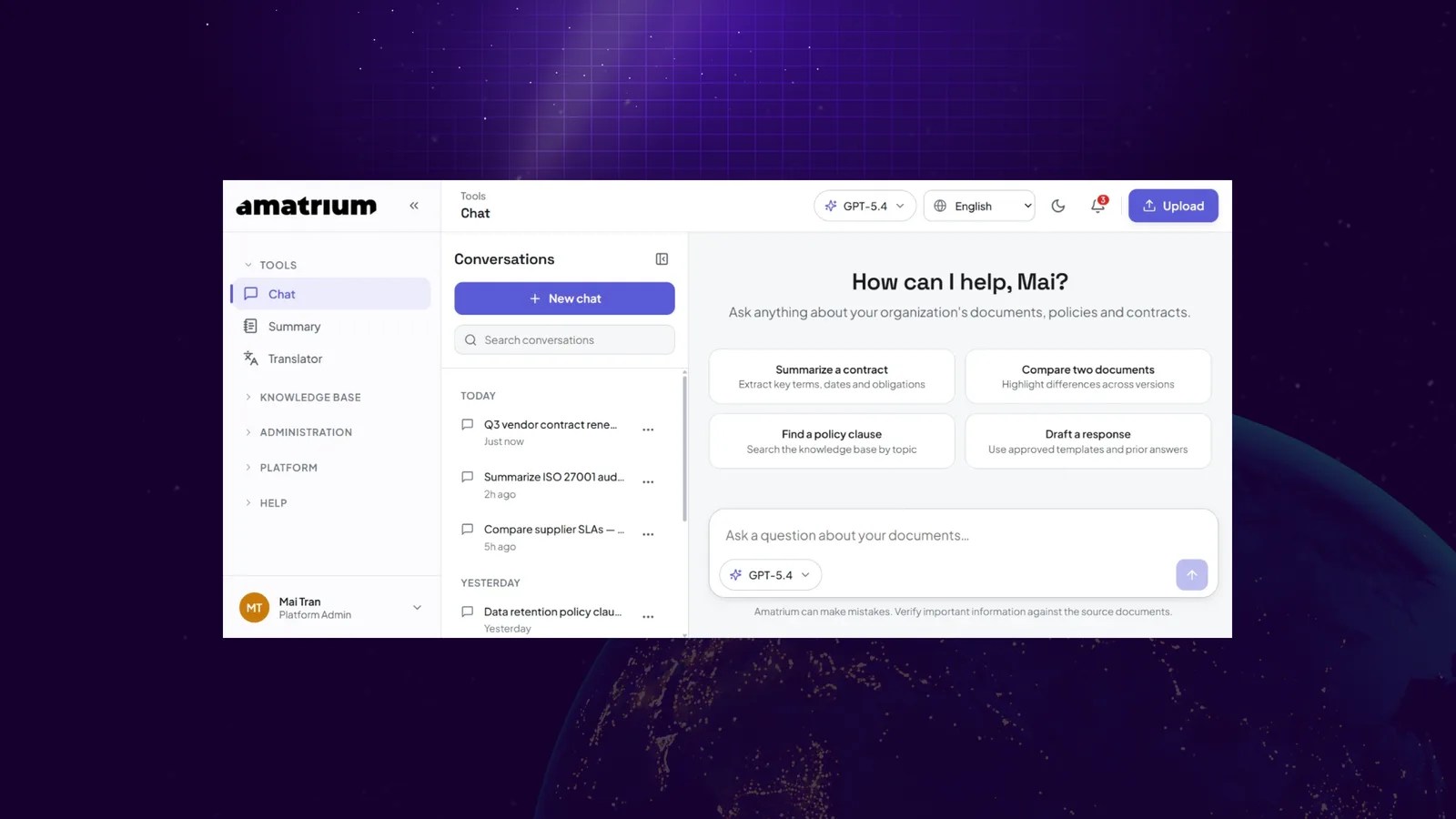
We built AmatriumGPT to help engineers find answers in Amatrium’s materials specifications and research reports. Each answer includes source links so engineers can open the documents and check the supporting evidence.
Before expanding access to more staff, a pilot with one business unit tested search accuracy and citations. For document queries, Amatrium estimates 30 to 40% less time compared with manual search.
Final words
Enterprise AI earns its place through the tasks people complete to the required standard. An answer has to hold up to review, and the person using it has to understand who has authority to act.
The next investment should follow a failure your team understands. A focused pilot gives the people handling that process a chance to report where it breaks down. Retesting corrections against the reported cases gives the process owner evidence for deciding whether to expand.