Engineering
enablement that sticks
after we leave.
Bring your team onto the Agentic SDLC: harness, specs, test-first habits and review gates, embedded alongside your engineers.
Trusted on systems that cannot fail















When AI adoption stalls at the individual level.
Most teams already use AI. Few have the harness, specs and gates that turn it into throughput you can plan around.
- 01
Adoption is individual, not organizational
Some engineers are three times faster. Nobody can say why, or repeat it.
- 02
Review has become the bottleneck
Generation is cheap, verification is not, and your seniors are drowning in it.
- 03
Quality varies by who used which tool
Without a shared harness, output quality is a personality trait.
Engineering enablement, from baseline to embedded coaching.
One team, accountable for the whole lifecycle, not a slice of it.
Maturity assessment
An honest baseline of how your team builds today and where the gains are.
Harness setup
The guides, sensors and hooks that steer AI safely inside your stack.
Spec-driven workflow
Teams move from ad-hoc prompts to structured, behavior-first specs.
TDD enablement
Test-first habits and tooling that make AI output verifiable.
Review-gate design
Human approval gates placed where judgment actually matters.
Embedded coaching
We work alongside your engineers until the practice sticks.
The working practice,
left with your team.
Harness, specs, tests and review gates your engineers run on their own once we step back.
Baseline
- Engineering maturity assessment
- Throughput and quality metrics as they stand
- Gap analysis against the Agentic SDLC
- Sequenced uplift plan
Enablement
- Harness: guides, sensors, hooks and rules
- Spec templates and worked examples
- TDD tooling and CI integration
- Review-gate design and checklists
Embedding
- Pairing and coaching with your engineers
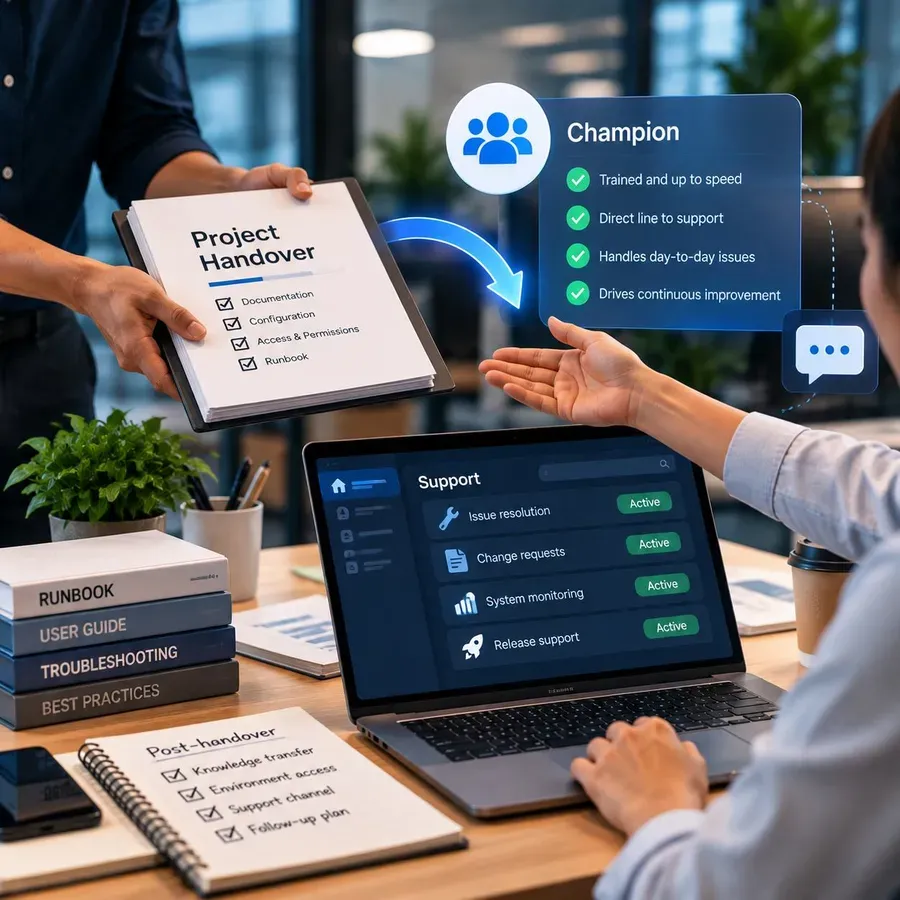
- Internal champions trained
- Playbooks and internal documentation
- Metrics dashboard and review cadence
- Your team runs the practice after we step back, without a standing retainer.
- Review time drops, because the gates catch what people used to.
- Onboarding shortens as written specifications replace tribal knowledge.
What changes,
measured against your baseline.
Every number comes from your own repositories and pipeline, before and after the uplift.
| Measure | Typical baseline | After uplift | How we measure it |
|---|---|---|---|
| Throughput | Typical baseline: Unmeasured | After uplift: 2-3× | How we measure it: Delivered scope per sprint, same estimator |
| Rework | Typical baseline: 25-40% of effort | After uplift: 40-60% lower | How we measure it: Commits reverting work merged in the last 30 days |
| Escaped defects | Typical baseline: Tracked loosely | After uplift: Halved or better | How we measure it: Defects found in production per release |
| Lead time | Typical baseline: Weeks | After uplift: Days | How we measure it: DORA lead time, commit to deploy |
| Traceability | Typical baseline: Unknown | After uplift: 90%+ | How we measure it: Traceability from spec to test to result |
If the baseline shows the constraint is somewhere other than engineering practice (an unstable codebase, an unclear product decision), we say so and point you at the service that actually fixes it.
Spec-driven, AI-assisted
delivery, governed end to end.
AI agents build. Senior engineers hold the gates. The framework that turns AI speed into governed, predictable delivery, from the first call through to support after launch, in five phases you can point at.
- 01
Assess
We map the system, risks and constraints. Honest, fast, no obligation.
- 02
Spec
Requirements become behavior-first specifications before any code.
- 03
Build
AI agents build from the specs; senior engineers hold every gate.
- 04
Govern
Tests, hooks and reviews enforce the standard continuously in CI.
- 05
Ship & scale
Release, observe and harden. Throughput grows as the harness learns.
- Faster time to market
- 30-50%
- Less rework and rip-out
- 40-60%
- Delivery throughput per engineer
- 2-3x
- Requirements covered by tests
- 90%+
What we build it with.
Chosen for what your team can operate and hire for, not for what is new.
AI tooling


Harness

Spec and test




Delivery



Adoption happens with your
engineers, not around them.
The operating model only holds if the people using it believe in it. Our engineers pair with your teams, run the reviews with them and hand the practice over once it runs without us.










How we work together
Three shapes. After the assessment we tell you which one fits, including when the answer is none of them.
Maturity assessment
You need a baseline before you commit.
- Commercials
- Fixed price, written uplift plan
- Typical duration
- 2-3 weeks
Pilot team uplift
Prove the practice on one team first.
- Commercials
- Fixed price, one team, one product
- Typical duration
- 4-8 weeks
Embedded enablement
Roll it out across your teams.
- Commercials
- Phased per team, milestone-based
- Typical duration
- 8-24 weeks
Every engagement starts with an assessment. It is fixed price, it ends in a written plan, and the plan is yours whether or not you continue with us.
Certified, accredited and independently reviewed





- Built to SOC 2 Type II criteria
- GDPR-compliant processing, DPA available
- NDA and IP assignment as standard
Explore other services
All servicesFrequently asked questions.
Something not covered here? Ask an engineer directly, no SDRs, no funnel.
Do our engineers have to switch AI tools?
Usually not. The harness sits around the tools your team already uses. We standardize how they are used, with specs, tests and review gates, not which tool is on the screen.
Can you do this while we keep shipping?
Yes. Enablement happens on your real backlog, not on a training project, so delivery continues while the practice is built.
How do we know it worked?
The assessment records your baseline first: throughput, rework, escaped defects, lead time and traceability. The same measures are tracked through the engagement, so the result is a number, not an impression.
What if engineering practice is not the real constraint?
Then the baseline will show it, and we will say so. An unstable codebase or an unclear product decision needs a different fix, and we point you at the service that addresses it.
What stays with us when you step back?
The harness configuration, spec templates, test tooling in CI, review checklists, playbooks, trained internal champions and a metrics dashboard. Your team runs it without a standing retainer.
Let's Work Together
German engineering discipline meets agentic delivery. Send a short note and we'll reply within one business day, straight to an engineer, no SDRs, no funnel.
- Email[email protected]
- Phone(+84) 246.276.3566
- Response TimeWithin 1 business day