Using AI to search company documents gives your teams a way to find answers in the information they already hold. The challenge is giving the application access to those records while keeping control over how it uses them. When the records contain sensitive information, that control becomes part of the deployment decision.
Private AI for business puts models in an environment your organization controls. The full application still has to enforce your data-handling rules, including across connected services. Your budget also has to cover the capacity and ongoing support required to keep it running.
This guide explains what private AI is and how the deployment options differ. You’ll learn how to weigh the control you require against the cost and effort involved, then use a pilot to guide your next investment.
What is private AI?

Private AI means running artificial intelligence in a setting where a business controls how its data is processed and who has access. The setup covers the model and the services handling sensitive records.
For private AI, you can use a model that has already been trained rather than train one from scratch. For example, a document assistant supplies relevant internal records to that model when an employee asks a question. The application must restrict those records to what the employee is allowed to read and protect any copies it stores.
Private AI, data residency, and sovereignty address different questions about how your data and AI environment are controlled. A private deployment needs rules for data location and control. Data residency concerns where data is stored or processed. Sovereignty concerns who controls the technology and which laws and service terms apply.
Private AI and public AI differ in who controls how your data is handled. With a public AI service, the provider processes your requests on its infrastructure under its service terms. Even if those terms rule out using your data for training, they still need to explain which records the provider keeps and for how long.
These data-handling commitments are separate from whether the service provides an environment reserved for your organization. A paid account alone does not establish that it does. The contract should identify who has access and which resources are reserved for your business.
How does private AI use your business data?
Private AI uses your business data through a model and the application around it. In a document assistant, the application finds relevant passages you have permission to read, then supplies them to the model to produce an answer.
Inference means running the model to produce an answer, while training changes the patterns it has learned. Retrieval-augmented generation (RAG) supplies relevant source passages during inference. That lets the model draw on current documents without a training run for every document update.
Our cloud-hosted enterprise AI knowledge hub uses retrieval to answer questions from company documents with source citations.
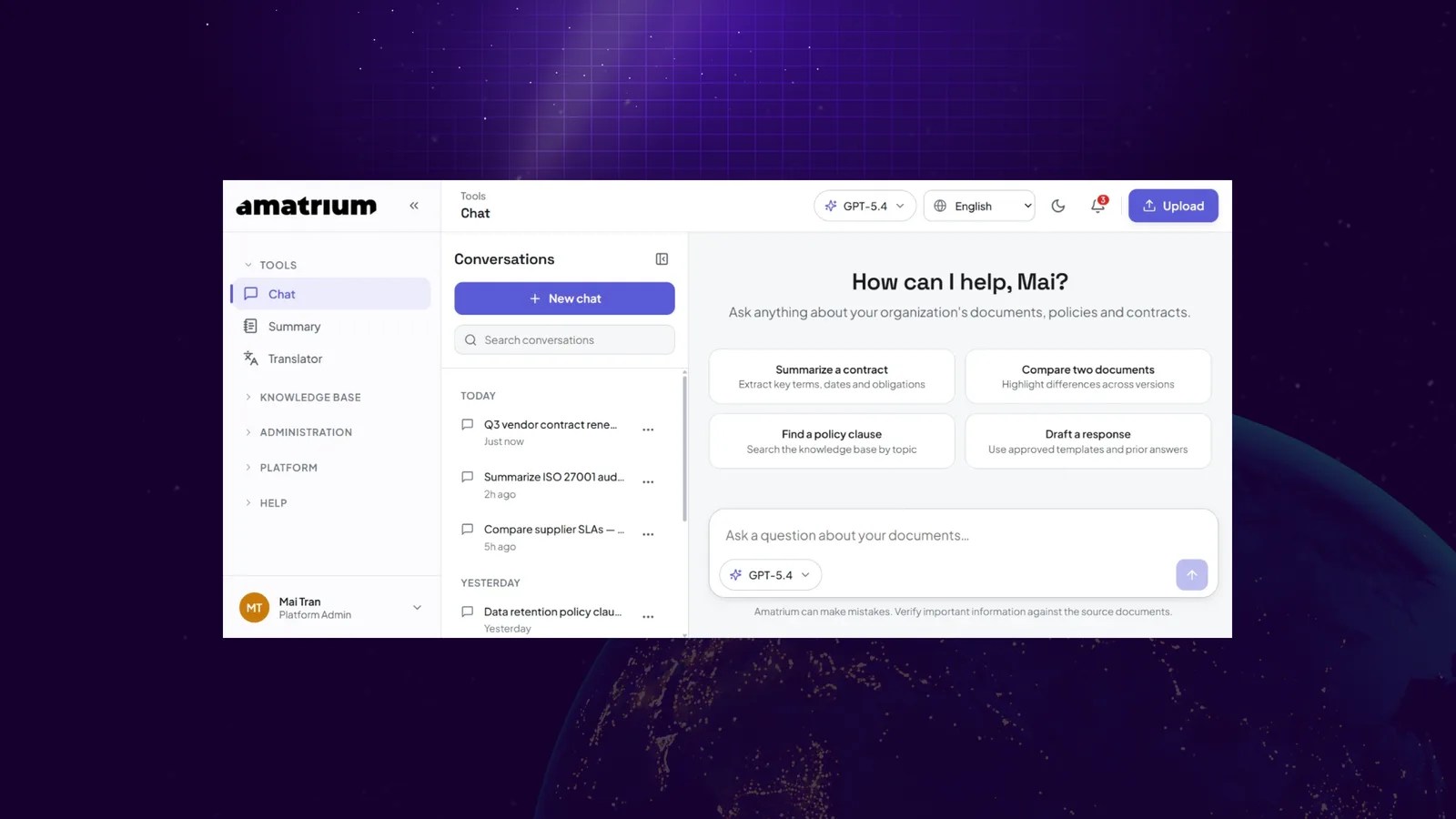
An employee signs in, and the application finds only passages they have permission to read. The model uses those passages to form an answer. The application returns it with citations. Activity records are kept under the logging policy.
A zero trust security design checks who is making each request and what they are allowed to access. In a document assistant, that means filtering passages by the employee’s permissions before they reach the model.
Citations give employees a way to inspect the evidence behind an answer. That evidence has to support what the answer says, so a source link is not proof of correctness.
When does private AI justify its operating cost?
Private AI is a practical option when a data-control rule excludes an otherwise suitable service, or when it lowers the full cost of acceptable answers. In either case, the business case has to include support after launch.
Data restrictions rule out otherwise suitable AI services
Private deployment fits when a data restriction excludes an otherwise suitable AI service. Your policy could limit where a provider processes documents or which parties receive them. A requirement to run without an internet connection narrows the options further.
The restriction needs to be precise enough to guide the design. Storing documents in a certain location is different from keeping their text away from an outside processor. A design that meets the storage rule still has to satisfy any processing restriction.
Regulated data calls for an assessment of the relevant rules and the service’s terms. It does not by itself rule out every cloud arrangement.
Demand and answer quality support the investment
A private deployment has an economic case when demand makes good use of its capacity and the answers meet your quality standard. Response deadlines matter as much as total request volume.
For example, consider a hypothetical comparison of response deadlines. An overnight batch of documents tolerates waiting in a queue, while an assistant used during customer calls has to answer while the caller waits. Those deadlines change how much capacity must stay ready.
Quiet periods leave fewer requests over which to spread hosting costs, while busy periods risk queues. The estimate therefore has to account for idle capacity as well as the capacity required to meet response deadlines.
A token is a piece of text processed by a model. A price per token describes that usage cost, while your full budget also includes support and the capacity kept ready between requests.
Staff review adds another cost beyond model usage. Savings on hosting shrink when employees spend longer correcting errors or repeating failed requests.
Your team is ready to operate the deployment
Your operating plan assigns responsibility for faults and for testing model updates before staff use them. If one specialist handles everything, their absence leaves a gap in support. The plan needs cover for that gap as well as routine maintenance.
Managed support transfers some of those duties to a provider, so the estimate has to show what the provider handles and what remains with your team. Those remaining duties belong in the cost comparison with an approved hosted alternative.
An AI readiness assessment records whether the required support and data-access arrangements are in place before a pilot starts.
Which private AI deployment model fits your business?
Your private AI deployment model must fit where processing is allowed and which duties your team will keep. The main options divide those duties differently:
| Option | When it fits | Operating responsibility |
| On-premises AI | Processing must remain at your site | Hardware, hosting, maintenance, and recovery |
| AI in your cloud account | Cloud processing is allowed within specified boundaries | Account, network, and service configuration |
| Managed private AI | Provider-operated isolation meets your requirements | Responsibilities split with the provider |
On-premises AI puts the hardware at your site, making procurement part of the launch schedule. Later budgets must account for replacement. If the installation stays off the internet, your team also needs a way to transfer tested software and model updates into it.
AI in your cloud account runs in an account you manage. A private cloud serves one organization exclusively; an account on a public cloud is a different arrangement. In either case, each connection to a search service or remote model has its own data path and terms. For each connection, establish where the service processes or stores document text.
Managed private AI transfers hosting duties to a provider. Its terms must identify the resources reserved for you and who has access to the records it retains. A clear division of maintenance duties helps you budget for the support your team will provide.
A hybrid design sends different types of requests to different environments. Its routing rules must keep restricted data away from unapproved services.
How much does private AI cost to deploy and operate?
Private AI deployment costs include the initial build and the expense of keeping the service running. The estimates need a common workload and answer-quality standard over the same period. Without that basis, a lower quote does not show that one option is cheaper to operate.
Which workload requirements affect private AI costs?
The length and timing of requests affect how much capacity the service requires. Longer requests give the model more text to process, while requests arriving together compete for that capacity. Your estimate also covers the time the service must stay ready between requests.
If the estimates use different models, test them on the same business questions. Public test scores help you shortlist models, but your own documents show whether they fit this use case.
Configuration also changes the comparison. In an October 2024 batch test, Anyscale reported 22% lower cost per token than Amazon Bedrock’s batch pricing.
Anyscale used Meta’s Llama 3.1 model with 70 billion learned values represented in a lower-precision number format. Requests contained 2,000 input tokens and 100 output tokens, with no common opening text.
What belongs in a private AI deployment budget?
A private AI deployment budget covers the application around the model and the people supporting it. These categories separate the initial build from the expenses that continue after launch:
| Cost category | What to include |
| Serving capacity | Hardware allocation or hosting charges; standby capacity |
| Retrieval and storage | Document processing, search, backups, retained records |
| Software | Model licenses and relevant platform subscriptions |
| Operations | Monitoring, updates, support, and incident response |
| Quality review | Answer evaluation, human review, and correction |
| Implementation | Integration, testing, deployment, and initial training |
Serving capacity covers the processors running the model. Many AI models use graphics processing units (GPUs), chips that handle many calculations at once. If you still pay for reserved capacity during quiet periods, that time belongs in the estimate. Owned hardware also brings power and site costs.
Retrieval and storage cover preparing documents for search and keeping the index current as records change. Your storage budget also covers backups and saved activity logs.
Software costs follow the model licenses and paid services you use. The license sets the permitted business uses, even when the model files are free to download.
Operations cover keeping the service online and fixing faults. Include the time existing staff spend on it as well as any outside support charges.
Quality review covers the effort to assess answers and correct errors. A response that costs little to generate becomes more expensive when it requires extensive review.
Implementation covers the initial build and launch. AI integration links the model to the records and business applications your staff use. Show this upfront cost on its own before spreading it across the period you are assessing. The total cost of ownership combines initial and ongoing expenses.
Cost per accepted answer relates your spending to the number of answers that meet your quality rules.
Cost per accepted answer = included cost ÷ answers meeting your acceptance criteria.
How does Eastgate price private AI delivery?
We price private AI delivery by the stage of the engagement. Architecture and sizing have a fixed price, followed by implementation priced per milestone. Managed AI operations use a monthly retainer for the ongoing support described in the engagement.
For your build budget, we provide a deployment design and a cost estimate through our architecture and sizing stage. We size hardware and storage for your workload and review security.
For outcome-based arrangements, a fixed fee covers delivery. A bonus applies only for periods when performance meets the target set for that engagement. Our private AI delivery and pricing structure describes these options. It does not publish standard dollar rates.
A delivery quote is only part of the budget. Hosting and third-party charges belong alongside it, so the comparison with another feasible deployment includes the same expenses.
How do you evaluate a private AI pilot?
A private AI pilot tests whether the design meets your requirements at an acceptable cost. Its tests need to reflect the documents staff will use and the demand the service will face.
If feasibility is uncertain, a proof of concept tests the approach on a small scale before a broader pilot.
1. Prepare questions from your business documents
Base the pilot’s tests on your document sample. Subject experts prepare questions with known answers, along with questions the documents do not answer. To measure performance on unfamiliar requests, keep a separate test set out of the build examples.
2. Check the accuracy and sources of AI answers
Reviewers assess the evidence behind each answer. In document search, that means confirming that the cited passage supports the claim and comes from a current document. Even if an answer sounds confident, it earns no credit when it invents a deadline.
3. Measure response times and answer-review effort
Performance tests use the demand conditions from your estimate. Under that workload, response times show whether the service keeps up during busy periods, while accepted-answer rates show whether quality holds. If staff must inspect answers before using them, record that time as well. That review effort affects costs even when the hosting bill stays the same.
4. Test document permissions and revoked access
Access tests establish whether the application respects document permissions. Test accounts with different access rights reveal whether restricted passages reach the wrong person. In addition, revoking access during the pilot shows whether search continues using old permissions. The application must enforce those rules even when a request asks the model to ignore them.
5. Decide whether to expand, retest, or defer deployment
A design that meets the requirements supports further investment. If a test exposes a fault with a credible fix, further pilot testing is a reasonable next step. By contrast, where the benefit is unproven or support is missing, you have grounds to defer deployment.
Finally, record the deployment decision and the evidence behind it. The decision record connects each feasible option’s costs to the demand tested and explains any remaining limits. It also identifies who will manage updates and provide ongoing support, so you know who will run the design you are funding.
Is private AI really private?
Private AI protects data only where the full design enforces your access and handling rules. An application still needs limits on sending documents to outside services, even when its model runs locally.
The assessment covers these questions:
- Processing: Where do prompts and retrieved passages go?
- Retention: Which records are stored, and for how long?
- Access: Who is permitted to read documents and activity logs?
- Connections: Which integrations transmit data beyond the approved environment?
A promise not to train on your data does not establish whether the provider processes or keeps it. Each commitment needs its own evidence.
If an assistant requests a change to a business record, permission to read that record does not by itself authorize the change. The application must enforce the permissions required to carry it out. Our framework for private AI and governed agent actions explains how those permissions relate to approvals and execution.
How should your business plan its private AI deployment?
Private AI gives your business a way to set the conditions for using sensitive information. Making it a sound investment also means funding the infrastructure and support required to keep it running. The right deployment meets your data rules and delivers acceptable answers at a cost you are prepared to sustain.
Start with one business use case and a sample of the records it will use. A pilot provides evidence about answer quality and operating effort. Use the findings to decide whether to expand the deployment or resolve the gaps before committing more budget.