Tâm Giao: A Vietnamese AI Voice Companion for Seniors
/ Healthcare / Vietnam / 2026 /
- First Commit to Live Pilot
- <8 weeks
- Late-Night Conversations
- 27%
- Health Alerts to Families
- 50+
First Commit to Live Pilot
Late-Night Conversations
Health Alerts to Families
Summary
Vision Bay built Tâm Giao to help families stay involved in the daily lives of older relatives who live apart from them. The voice-first web app gives each elder a Vietnamese-speaking AI companion called An, powered by Claude Sonnet 5.
An holds daily conversations, learns the elder's life story, and delivers medication and appointment reminders. A caregiver dashboard keeps family members informed.
Eastgate worked alongside Vision Bay's developers on product design and engineering, then ran the campaigns that recruited the pilot cohort. Tâm Giao was live with pilot households in under eight weeks and reached full production in mid-September 2026.
The Challenge
No app install. No typing. Just conversation.
Typing was the first barrier
Tâm Giao was built for people in their seventies and eighties. A text chatbot would place a keyboard between the user and the product, so every interaction had to run in spoken Vietnamese. The conversation also had to feel natural enough that an elder could respond as they would to a grandchild.
Installation was a dead end
Searching an app store, installing an app, and managing updates create several chances to lose an older user before the first conversation. Tâm Giao therefore runs as a progressive web app (PWA) that opens from a link on the family's existing phone.
Families lacked a daily signal
For an adult child living in another city, a weekend phone call cannot answer today's questions. Did their parent take their medication? Eat lunch? Speak to anyone? The caregiver dashboard had to close that daily information gap.
A small team had to ship the whole system
The voice app, AI-agent backend, caregiver dashboard, reminder scheduler, and deployment pipeline all had to come from a team of three to five people.
The Solution
A Vietnamese-speaking AI companion built around each elder
01 One tap starts the conversation
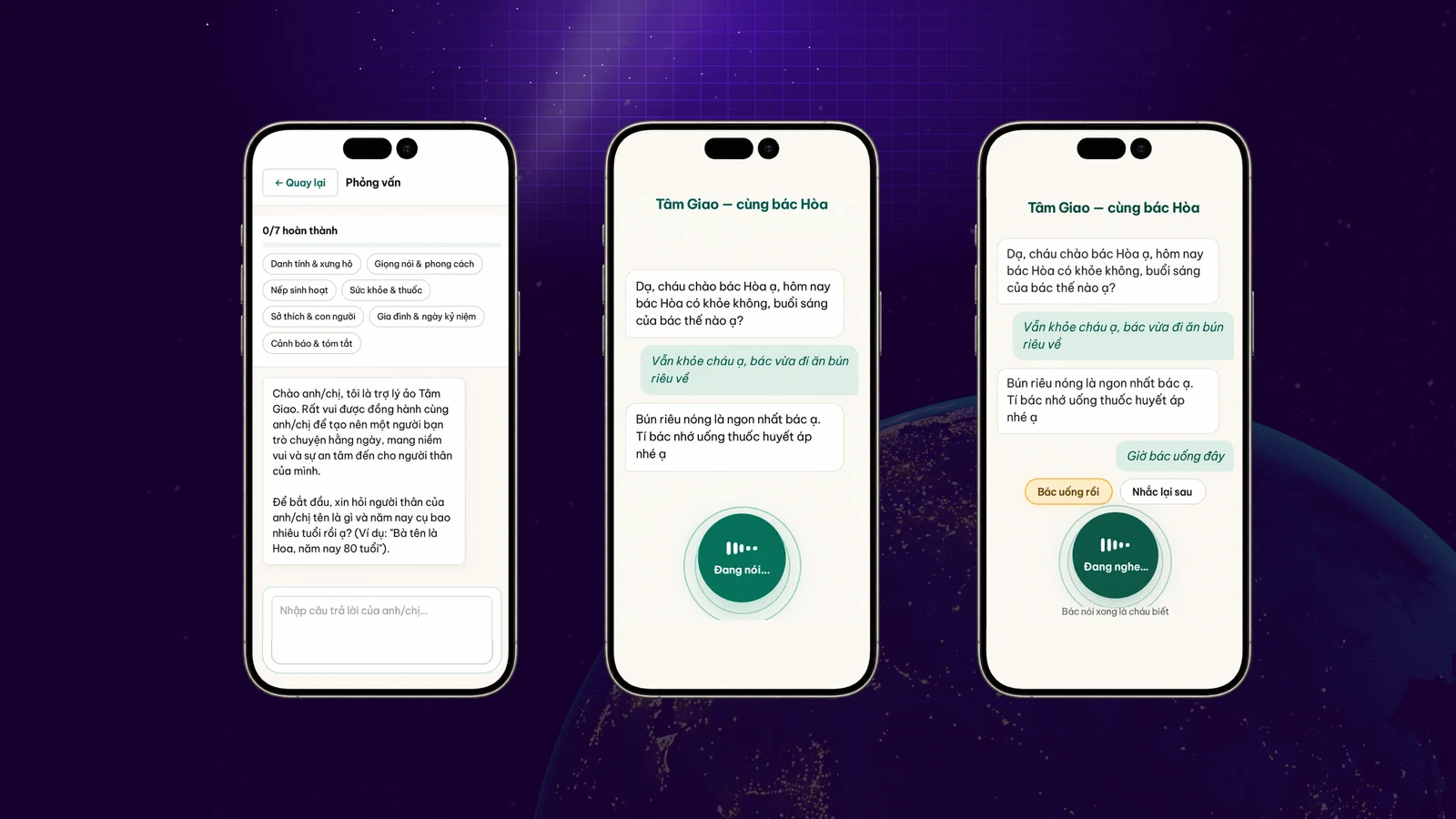
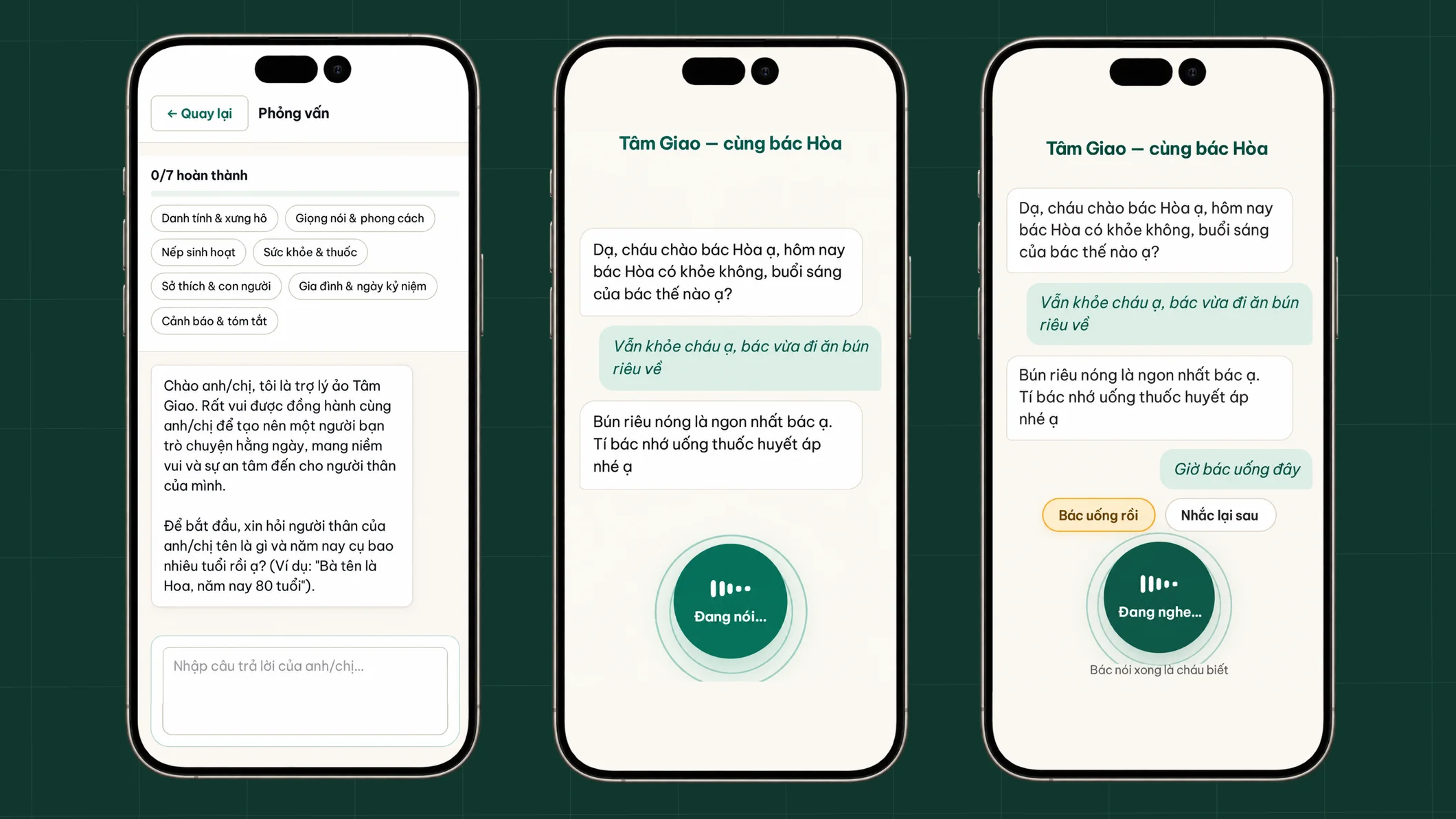
An opens the conversation in Vietnamese and keeps the entire interaction in speech. Powered by Claude Sonnet 5, An listens and replies aloud while the screen displays a transcript instead of a control panel.
The elder taps once and talks, using an interface they already understand: conversation.
02 A guided interview builds the context
Before the first conversation, a family member guides An through seven areas: where the elder lives, how they prefer to speak, their daily routine, health and medication, important people and interests, family dates, and situations that should trigger an alert.
Claude Sonnet 5 uses these answers as structured context for An's daily conversations. By the first call, An already knows who it is speaking with.
03 Reminders become part of the conversation
Scheduled web push notifications bring medication and appointment reminders into the conversation. An mentions each reminder as part of the dialogue instead of playing an alarm.
The elder can confirm with one tap or ask An to remind them later. The family follows the response through the caregiver dashboard instead of calling to check.
04 An embedded team covered product and growth
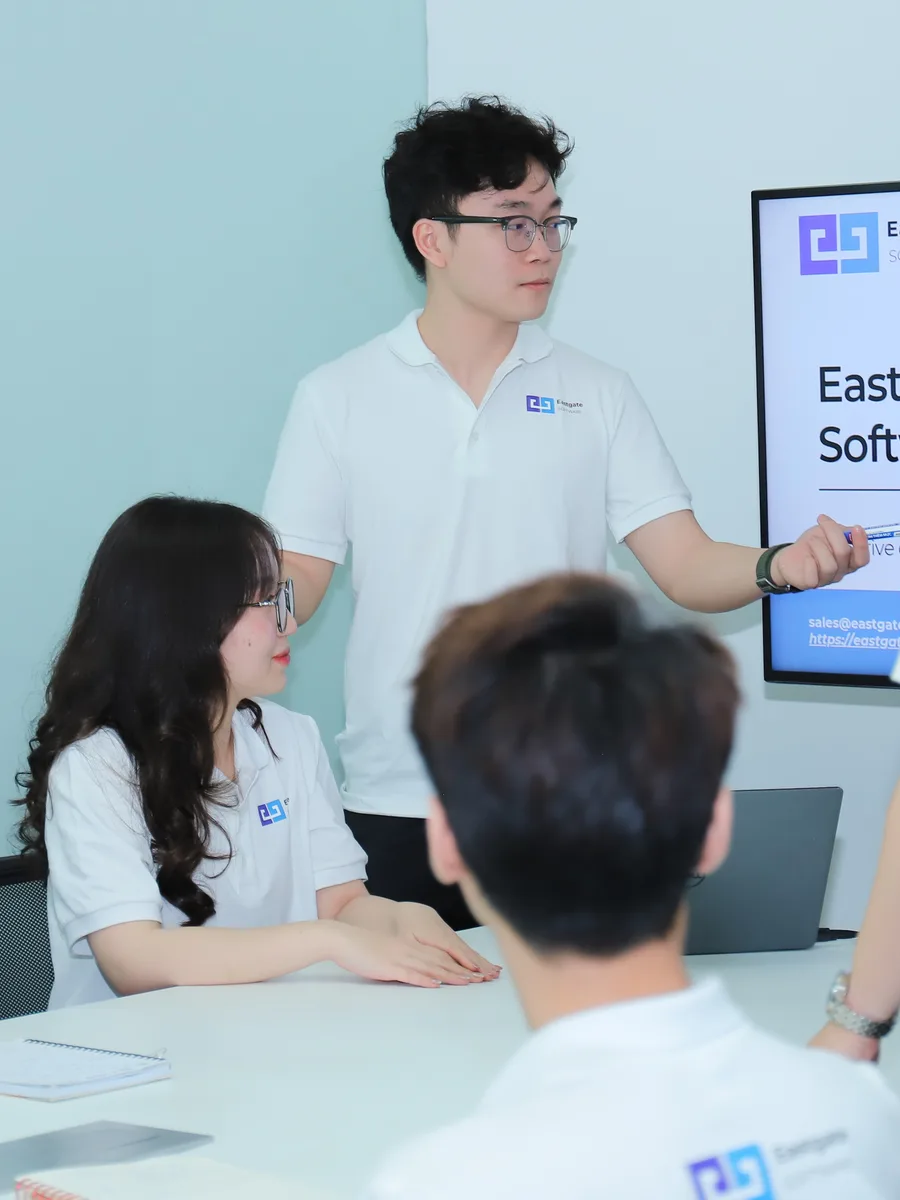
Eastgate worked alongside Vision Bay's developers, leading design engineering and running the campaigns that recruited the pilot cohort.
The team used Claude Code throughout the build and added per-user usage and cost tracking before launch, not after the first invoice arrived.
Inside the build
The Results
From first commit to live pilot in under eight weeks
Under eight weeks to a live pilot
About 230 commits from 4 July 2026 produced the Vietnamese voice PWA, AI-agent backend, caregiver dashboard, scheduled web push reminders, and Google Cloud CI/CD pipeline. Tâm Giao went live with real families in early August, two weeks ahead of the original build plan.
A team of three to five people delivered the complete system without hiring beyond the core team. Per-conversation cost tracking was built before launch, so Vision Bay sets its price from real usage data instead of waiting for the monthly cloud bill.
Production two weeks early
Tâm Giao moved into full production in mid-September 2026, two weeks ahead of schedule. The early launch let Vision Bay start its campaign to bring in more users and grow the product.
Claude supported four operational areas: deployment, infrastructure provisioning, security, and monitoring. It also flagged configuration drift before release, helping the team reach full production without a dedicated DevOps or SRE engineer.
27% of conversations happen late at night
Between 25 and 30 pilot participants and their families use Tâm Giao. Twenty-seven percent of elder conversations took place between 21:00 and 01:00.
Those are the hours when no family member or carer is usually available, and An is still there to talk.
50+ alerts reached families
During the pilot, An sent more than 50 alerts about elders' physical or mental health directly to their children's phones.
Each alert reached the family when it mattered, instead of waiting for the next weekend phone call.
Tech Stack
- Frontend
 Web Push
- AI/ML
 Claude APISpeech-to-textText-to-speech
- Infrastructure

- CI/CD
- Continuous deployment
- Tools

Let's Work Together
Tell us what you're building. Our engineers will respond within 1 business day with a concrete next step - no sales script, no obligation.
- Email[email protected]
- Phone(+84) 246.276.3566
- Response TimeWithin 1 business day