AI-Powered Predictive Maintenance System
/ Manufacturing / Japan / 2020 /
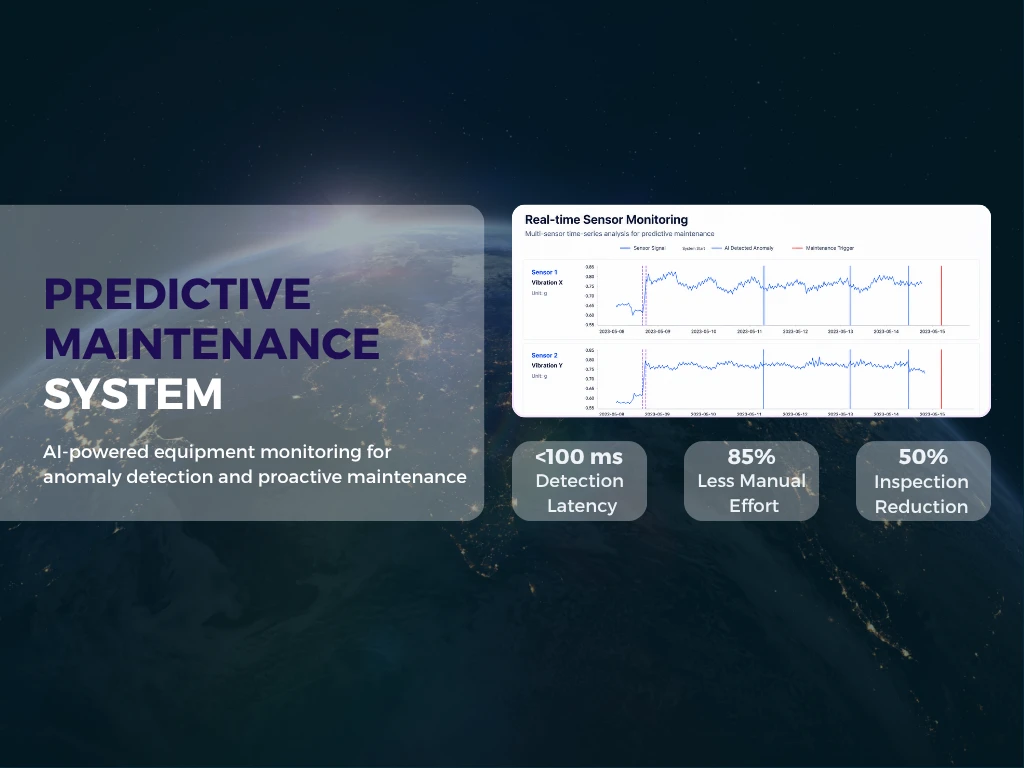
- Detection Latency
- <100 ms
- Less Manual Effort
- 85%
- Inspection Reduction
- 50%
Detection Latency
Less Manual Effort
Inspection Reduction
Summary
A transportation organization in Japan needed to know the condition of its motors while they were running, across varying stress levels and workloads. Manual inspection was labor-intensive and could not scale to continuous monitoring, so faults surfaced on an inspection schedule rather than when they appeared. We built an anomaly detection system that applies time-series analysis to three-axis vibration and workload sensor data, processes frequency data across multiple operating conditions, and raises automated alerts as part of continuous condition monitoring.
The Challenge
Motors under changing load, and inspection that could not scale with them
Needed to monitor motor operating conditions in real time across varying stress levels and workloads
Required early detection of anomalies from high-frequency sensor data before failures occurred
Manual inspection was labor-intensive and could not scale to continuous monitoring
The Solution
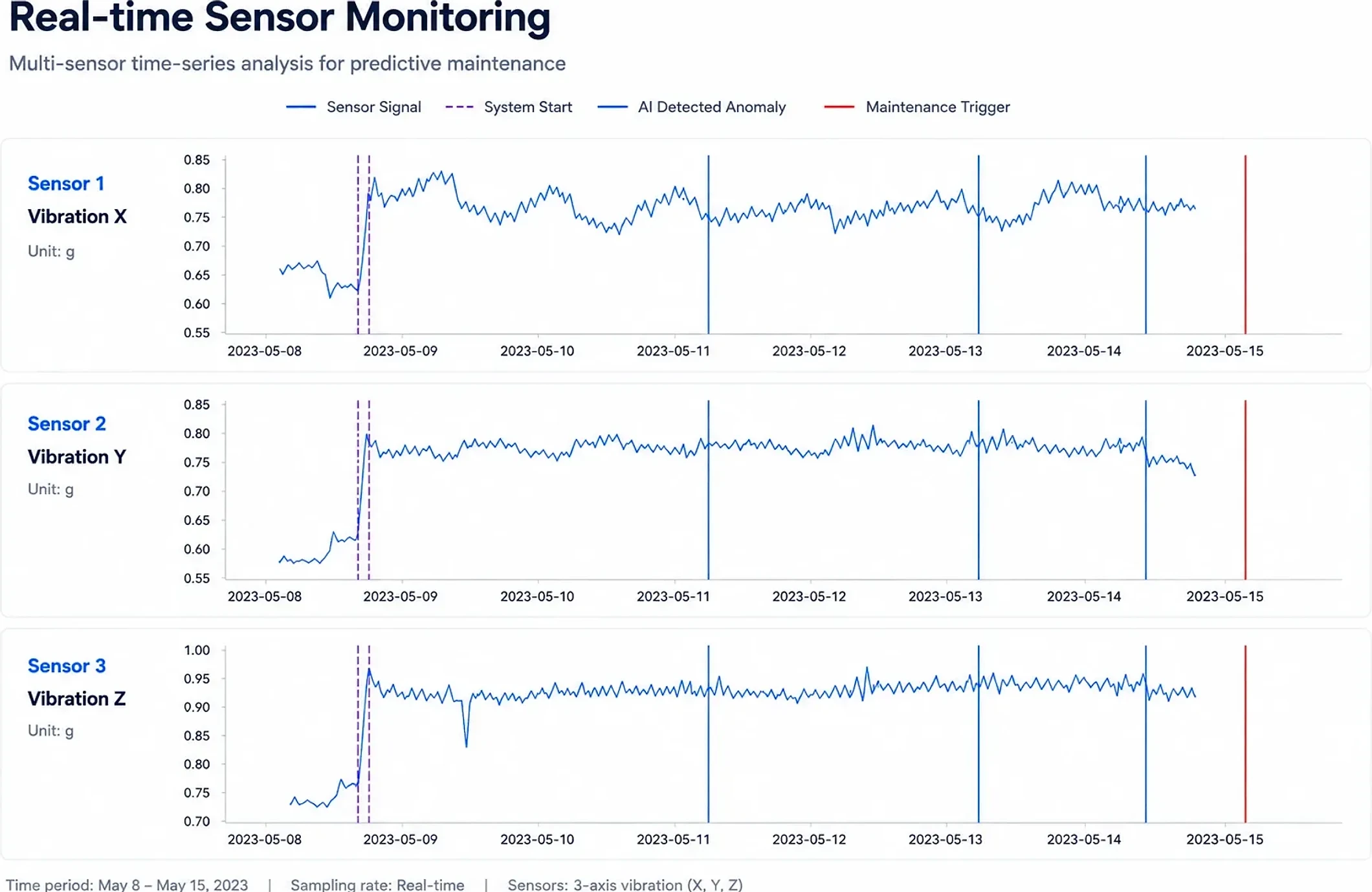
Anomaly detection built on three-axis vibration and workload data
01 An AI anomaly detection system
Built an AI-based motor anomaly detection system that reads vibration and workload sensor signals from motors in service, so condition is assessed continuously instead of at scheduled inspection intervals.
02 Three-axis time-series analysis
Applied time-series analysis to vibration and workload data across all three axes (X, Y, Z). Reading the axes together is what separates a genuine anomaly from normal variation when stress levels and workloads keep changing.
03 Frequency data across operating conditions
Processed frequency data from motors running under multiple operating conditions, so detection stays reliable across the full range of stress levels and workloads rather than against a single baseline.
04 Automated alerts and continuous monitoring
Delivered automated anomaly alerts alongside continuous condition monitoring. Detection reliability improved and the dependency on labor-intensive manual inspection dropped with it.

Inside the build
The Results
Faults flagged in under 100 ms, with half the inspections
A fault announces itself
Under 100 ms detection latency for real-time anomaly alerts
Engineers off the ladder
85% reduction in manual inspection effort
Half the site visits gone
50% fewer inspections through condition-based monitoring
One rule for every motor
More consistent fault detection across varying operating conditions
Tech Stack
- Backend

- Data
- Sensor Data Processing
- AI/ML
 Time-series ML
Let's Work Together
Tell us what you're building. Our engineers will respond within 1 business day with a concrete next step - no sales script, no obligation.
- Email[email protected]
- Phone(+84) 246.276.3566
- Response TimeWithin 1 business day