Build vs. buy software means choosing whether to create custom software for a specific need or purchase an existing SaaS product. However, in 2026, most companies have a third practical option.
Today, most enterprise software decisions involve three delivery routes. A company can build with an in-house team, buy an off-the-shelf product, or hire an engineering partner to build a custom solution. The right choice depends on how important the software is to the business, the capability of the internal team, and the budget of the company.
A poor choice can be costly. In a McKinsey and Oxford study of more than 5,400 large IT projects, projects with budgets above $15 million ran 45 percent over budget and delivered 56 percent less value than expected. Maintenance adds another long-term cost. Even with the new AI tools that can speed up parts of development, they do not remove the need to compare ownership, risk, and long-term support.
This framework compares the cost of building in-house, buying software, and working with an outsourced partner. It also provides a scorecard for your own situation, explains why capable teams still make poor choices, and shows where AI-assisted development changes the decision.
Why Build vs. Buy Is Too Narrow

Most build vs. buy decisions use two columns: build it yourself or buy it off the shelf. However, this simple model assumes that building always requires a permanent in-house team and that buying means accepting a SaaS product as it is. In practice, companies have more flexibility than that.
The Market Has Already Moved Beyond Two Options
Hybrid models are getting more common. One is “buy and extend,” where a company customizes a configurable platform instead of replacing it. Another is a partner-led custom build.
Strictly speaking, buy and extend remains a form of buying, while outsourced development remains a form of building. Still, they change the cost and ownership model. For example, a company can hire an engineering partner to create in-house custom software and include ongoing support in the contract. This route offers more control than a standard product without requiring the company to hire every role internally.
Two Common Failures Caused by a Two-Option View
Most companies run into one of two problems:
- Overbuilding. A team creates a permanent internal function for a capability that does not set the business apart. Often, this happens because buying feels like giving up control.
- Underserving. A team buys a product and then works around its limits for years. The product may cover most needs, but the missing 10 to 20 percent can be costly or impossible to add.
In both cases, the team may have avoided the problem by comparing a partner-led build as well.
Build: What Are You Really Committing To?

Pros of Building Software In-House
- Full control: Your team sets the roadmap and decides when features ship.
- A closer fit: The software can match your workflows instead of forcing the business to adapt to a standard product.
- Strategic value: When the capability genuinely sets the business apart, owning the software can justify the added cost.
Cons of Building Software In-House
- Ongoing maintenance: After launch, the system still needs monitoring, security patches, updates, support, and regular improvements.
- Higher long-term costs: Plan to spend 15 to 25 percent of the original build cost on maintenance each year. The amount varies by age, risk, and complexity.
- Technical debt: Delayed maintenance can turn small issues into a larger and more expensive project later.
- Opportunity cost: Internal maintenance takes engineers away from growth work. For common capabilities such as payments, a specialist product may cost less overall.
Many successful software products began as internal tools that solved a distinct problem. Later, once the internal version proved useful, the company turned it into a product. That said, the key question is not whether the team can build the software well.
Instead, ask whether the software supports a real competitive advantage or simply recreates a common product. A custom tool for a unique process can become a valuable asset. By contrast, rebuilding a capability that several vendors already offer may leave the company paying ongoing maintenance without gaining a meaningful advantage.
Buy: The Limits You May Not See at First

Pros of Buying Off-the-Shelf Software
- Fast launch: A ready-made product can go live in days or weeks rather than months.
- Lower maintenance burden: The vendor handles much of the infrastructure, patching, and product maintenance.
- Easier upfront planning: License and implementation costs are usually easier to estimate than a custom build.
- Strong fit for common needs: Mature products often work well for payments, data warehousing, business intelligence, and capabilities with heavy security or compliance demands.
Cons of Buying Off-the-Shelf Software
- Coverage gaps: A product may meet most needs, while the final 10 to 20 percent is difficult or impossible to configure.
- Vendor dependency: Pricing, support, and the product roadmap remain outside your control. Updates may slow, or the vendor may close the product.
- Switching risk: An acquisition, market exit, or pricing change can force a costly and unplanned migration.
- Internal work remains: Your team still needs to manage integration, configuration, data migration, training, and oversight.
- Higher total cost: The license fee is only one part of the cost. Customization, usage, support, and switching costs also matter.
- Accountability stays with the buyer: Using a vendor does not remove your data, security, or regulatory duties.
Still, buying is not automatically the safer or simpler choice. A mature product can shorten the launch and reduce maintenance, but only if it fits the business well enough. A fast start loses value when the team spends years working around missing features, weak integrations, or rising fees.
Ask whether the product supports the workflows that matter most and whether your company can switch to another solution without major disruption. Review data portability, contract terms, future pricing, support quality, and the vendor’s product direction. If those risks are manageable, buying can free the team to focus on work that gives the business a real advantage.
Outsourced Software Development: The Third Option
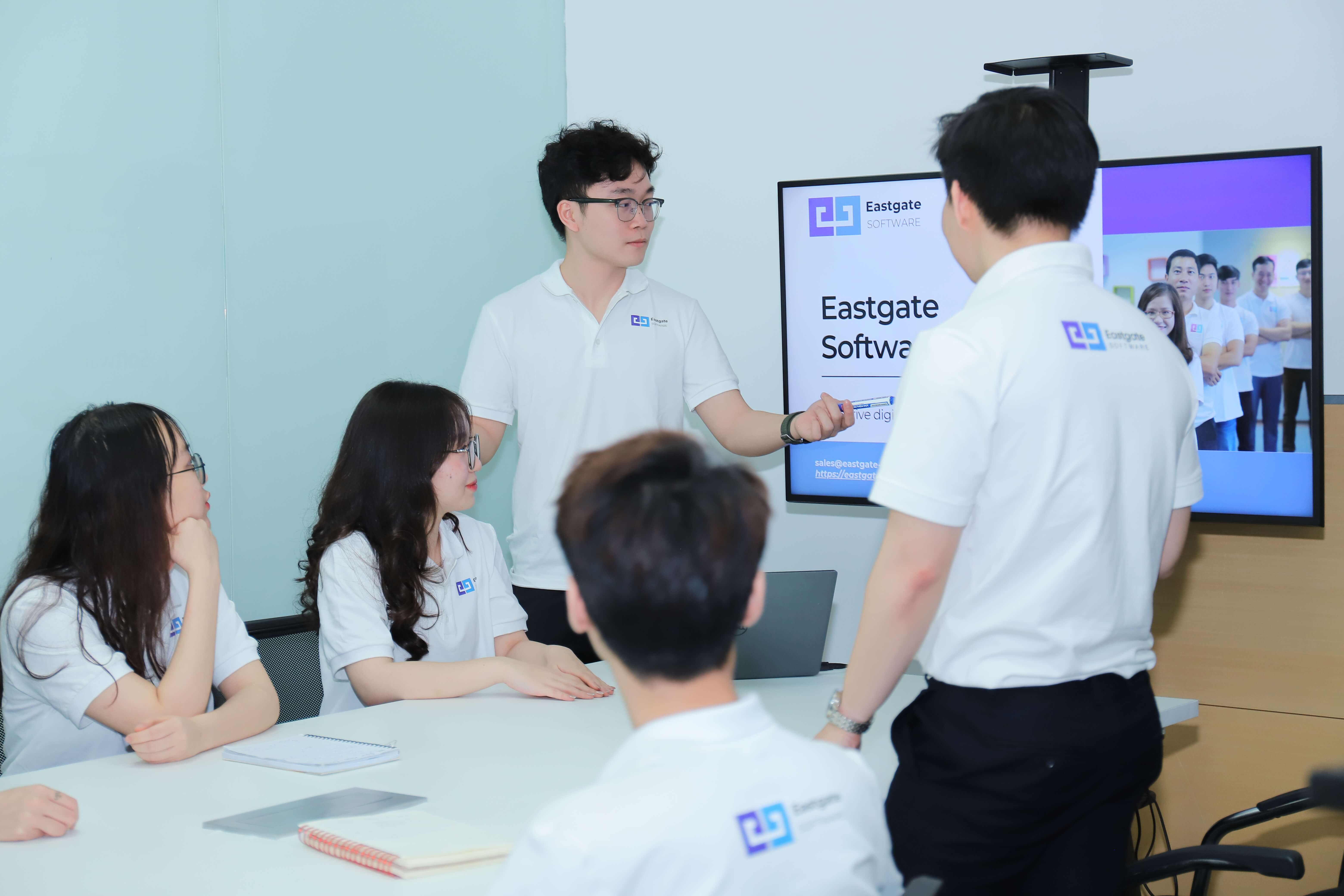
How Does Outsourced Software Development Work?
A partner builds software for your needs and supports it after launch. This route often starts faster than hiring a full internal team and offers more flexibility than a standard product.
Support can be defined through clear service levels, responsibilities, and costs. However, if the contract is vague, the maintenance burden may fall back on the internal team.
How to Choose a Software Outsourcing Partner
Before choosing a custom software development company, check communication, delivery standards, and support responsibilities. Quality varies, and a poor fit can be expensive to correct.
At Eastgate, we name risks early and define the maintenance handover before delivery. As a result, the software remains secure and supportable after launch.
Software Outsourcing vs. Staff Augmentation
Staff augmentation adds contractors to an existing team. They work under the client’s direction and complete assigned tasks.
This model adds capacity, but it rarely transfers responsibility for the result. A delivery partner may own agreed outcomes such as reliability, security, and maintainability. Therefore, confirm which model the contract provides.
Compliance and Security in Software Outsourcing
A partner with relevant certifications and experience can help design controls, prepare evidence, and support audits. However, the client remains accountable. Eastgate brings ISO, SOC, and GDPR experience to mission-critical systems from the start.
Leaving this route out forces a choice between two imperfect defaults. For more detail, including regulated hybrid models, read our guide to in-house vs. outsourcing software development.
Build vs. Buy Software Scorecard
To move from discussion to action, score your situation against the same set of criteria. The table below compares an in-house build, an off-the-shelf purchase, and a partner-led build.
| Criteria | Build In-House | Buy Off-the-Shelf | Partner-Led Build |
| Competitive advantage | Strong fit for true differentiators | Strong fit for common capabilities | Fits custom needs when internal capacity is limited |
| Compliance and security | Internal team builds and maintains the controls | Vendor may reduce the workload, but the buyer remains accountable | Partner may bring relevant controls and experience; the client remains accountable |
| Time to launch | Usually the slowest route | Usually the fastest route | Often faster than hiring a full internal team, but slower than buying |
| Internal capacity | Needs sustained internal staff | Needs integration, oversight, and vendor management | Reduces the delivery load, but still needs internal ownership |
| Estimated five-year cost | Build cost plus ongoing maintenance | Licenses, integration, change, and switching costs | Contracted delivery plus support, transition, and governance costs |
| Customization | Highest control | Limited by the product and vendor roadmap | High control within the agreed scope and architecture |
| Dependency risk | Depends on key staff and internal knowledge | Depends on the vendor, contract, and exit options | Depends on the partner, contract, documentation, and handover plan |
Build vs. Buy Software Decision Rules
Use these signals as a starting point, then adjust the score for your system’s risk, complexity, and importance to the business.
- Buy: The product covers 80 to 90 percent of the need, the deadline is tight, and customization is modest.
- Build in-house: The capability sets the business apart, and the team has enough time and capacity to own it long term.
- Use a partner-led build: The requirements are custom, but internal capacity is limited or specialist delivery support is needed.
For a build, start with annual maintenance of 15 to 25 percent and adjust for risk. For a purchase, review exit costs, data portability, and continuity plans.
Build vs. Buy Software Examples
Analytics dashboard: A Series B SaaS company needs a common customer-facing dashboard this quarter, while its internal engineers are committed to the core roadmap. Buying and extending an existing analytics platform is likely the better fit.
Regulated access control: The same company needs a permissions system that standard products cannot support. Compliance matters, the need is more distinct, and internal capacity is still limited. A partner-led build is now the stronger option.
The result changes because the criteria changed, not because one delivery route is always better.
Why Capable Teams Still Make The Wrong Decision
In many organizations, teams build when they should buy, or buy when they should build, because incentives and past experiences shape the discussion.
Job Security and Knowledge Concentration
The engineers who build a system often become the only people who fully understand it. Their expertise is valuable, but it also creates a risk. A recommendation to build may be influenced by who gains control or becomes hard to replace, even when nobody says so directly.
The answer is not to distrust engineers who recommend building. Instead, separate the proposal from the person making it. Use the same scorecard, evidence, and review process for every option.
Not-Invented-Here Thinking
Sometimes, resistance to buying has little to do with cost. The team may simply believe it can build a better product without first testing that belief. This is often called not-invented-here thinking. Because it sounds like technical judgment, it can be hard to spot.
A common warning sign is confidence without comparison. If nobody has reviewed the available products, the claim that an internal version will be better rests on instinct rather than evidence.
Resistance After a Forced Software Purchase
A poor software purchase can affect every decision that follows. If leaders selected the last product without involving its users, engineers may resist the next recommendation to buy. The practical fix is simple: involve the people who will use, integrate, and maintain the software during the evaluation, not only after the choice has been made.
Scoping Too Little Before the Decision
Teams often test a build idea against only the most common use cases. The problem looks simple, so they commit. After launch, edge cases appear one by one. The company then adds people and development time to a system that was expected to stay small.
The reverse can happen when buying. A vendor demo shows the main workflow, but important gaps appear only after the team starts to use the solution. Therefore, both routes need realistic scenarios, edge cases, integration checks, and exit planning before a decision.
Does AI-Assisted Development Change the Decision?
Tools such as Cursor, Claude Code, and GitHub Copilot can help a well-defined feature move from idea to prototype more quickly. This is a meaningful change. As a result, some teams may now consider building software they would have bought a year or two ago.
However, AI changes only part of the work. A faster first version still needs testing, monitoring, security review, documentation, and maintenance. Compliance duties do not disappear because AI drafted some of the code. In addition, knowledge risk may grow when code is produced quickly but reviewed by too few people.
Speed is not the same as stability. A feature may be quick and cheap to prototype with AI, yet still be costly to secure, maintain, and improve. Those long-term duties remain, no matter how fast the first version was created.
Final words
Build vs. buy is no longer a useful two-column exercise. A stronger decision compares three practical delivery routes and scores them with evidence, not instinct or internal politics.
Start with one quick check. If the capability truly sets the business apart, a standard product may be too limited. So, compare an in-house build with a partner-led custom build. Even then, review existing products and configurable platforms before deciding that a custom build is necessary.
Also, revisit the decision over time. Team capacity, product options, prices, and AI-assisted development all change. As a result, a route that scored well last year may not be the best choice today.
If the scorecard points toward custom development, Eastgate can help you compare an in-house build with a partner-led approach. We work with engineering leaders to define the trade-offs, ownership model, and total cost before development starts. Talk to our team about your situation now.