Most microservices best practices fail because your team adopts all of them at once, before the system or the team is ready.
The friction shows up in your production environment. Schema coupling your team won’t notice until a service needs to scale independently. Retries that quietly duplicate your transactions. Local environments no developer on your team can run without standing up the entire stack.
Your service design, data ownership, resilience, observability, deployment, and security all matter. But, your sequencing judgment and real production experience are what decide whether any of it survives contact with a live system instead of just a whiteboard.
The twelve practices below cover everything from your first boundary decision to the sequencing calls most teams get wrong. None of them is difficult to understand in isolation. Getting the order right is where most migrations actually struggle.
1. Draw service boundaries around business capabilities, not tech layers
A service boundary drawn around a technical layer, a “database service” or an “API layer,” breaks the moment two business capabilities need different release schedules. A boundary drawn around a business capability, such as payments, orders, or inventory, doesn’t.
Use bounded contexts to find the seams
Domain-Driven Design’s concept of a bounded context is the fastest way to find these seams before writing any code. Rather than guessing where the lines should go, map your business capabilities first: what changes together, what your team owns, what has its own lifecycle. The seams usually follow those lines more naturally than a technical diagram would suggest. For the foundational design principles this builds on, see our breakdown of the 12 design principles of microservices.
Expect to get the first attempt wrong. If you start with narrowly scoped services, you’ll likely end up merging some of them once real usage patterns show which capabilities change independently and which don’t. Starting slightly broader and splitting later. Once that evidence exists, it causes far less rework than over-decomposing on day one and discovering two “independent” services always deploy together anyway.
Mirror team ownership to service ownership
Your team structure should mirror your service structure. A service without clear, named ownership drifts. Nobody takes responsibility for the technical debt. Nobody has the authority to push back on scope-creeping feature requests. As a result, boundaries blur over time regardless of how cleanly they were drawn originally.
Consider what happens when payment processing logic gets added directly to an order management service. The order service grows to handle orders, payments, and notifications in one codebase. When your payments team later needs to add a new payment gateway, they’re working inside code that also handles order tracking, and a change intended only for payments risks breaking something unrelated.
A clean boundary avoids that coupling. Your payments team ships independently, and the order service never needs to know how a refund gets processed.
The boundaries that hold up under a real monolith-to-microservices migration are consistently the ones drawn around what your business actually does, not around what your existing codebase happens to look like.
2. Give every service its own data storage

Shared databases are the fastest way to turn “independent” services back into a monolith with extra network hops. The service split might look clean on an architecture diagram. But if two services read and write the same tables, a schema change in one still requires coordinating with the other. That coordination cost doesn’t disappear just because the code lives in separate repositories.
Data access should go through APIs, not direct table reads across service boundaries. This is what preserves independent deployability, more than the service split itself. Independent deployability, not the number of services running, is the real defining trait of a microservices architecture. If your team can only detect breaking changes during integration testing, you’ve already violated that boundary somewhere.
Polyglot persistence, using a different database type for each service, is a benefit of this pattern, not a requirement of it. Forcing a document database onto a service that would be simpler with a relational one adds operational cost for no real gain.
There’s also a legitimate middle ground here. If you’re migrating off a monolith, you might start with a shared database and strict schema-level separation. Using separate schemas or namespaces for each service’s data, before physically splitting the database later. That’s a transitional step, not a violation, as long as the separation holds and each service only touches its own tables.
None of this is free. More databases mean more infrastructure, monitoring, backup, failover planning, and more places that a misconfiguration can hide. Data isolation earns its cost back in independent scaling and safer schema changes. Budget for the operational overhead honestly, rather than treating database-per-service as a zero-cost best practice.
3. Put an API gateway between clients and everything else

Your clients should know about one endpoint, not the internal topology of a dozen backend services. An API gateway sits between external requests and the services that fulfill them. It gives mobile apps, web clients, and third-party integrations a single, stable surface to talk to, despite how the services behind it are organized or how often they change.
The gateway’s job is authentication, rate limiting, and request logging, not business logic. Once business rules start living in the gateway, every service behind it has a hidden dependency on gateway behavior that isn’t visible anywhere in its own code. A change to that logic now has to be tested against every service it touches.
For example, validating an auth token belongs in the gateway because it’s the same check for every request. Calculating an order total doesn’t, because that logic is specific to one business capability and should live inside the service that owns it.
Internal service-to-service calls should mostly bypass the gateway entirely. Routing every internal request through the same front door adds a network hop and a shared point of failure that doesn’t need to be there. Direct service-to-service calls or a service mesh for complex internal routing and observability needs handles that traffic more efficiently. It also keeps your gateway focused on the one job it does well.
4. Choose sync or async communication on purpose, not by default

REST-everywhere and events-everywhere are both defaults that fail. The right communication pattern depends on whether your calling service needs an answer right now or can move on and let the response arrive later.
Synchronous calls, over REST or gRPC, make sense when the caller can’t proceed without a response. For example, checking whether an item is in stock before confirming an order is a reasonable synchronous call, since the checkout flow can’t meaningfully continue without that answer.
Asynchronous messaging, through a broker like Kafka or RabbitMQ, fits services that don’t need to block on each other. Once an order is placed, notifying the warehouse and updating analytics don’t need to happen before the customer sees a confirmation. Publishing an event and letting downstream services react on their own time keeps the checkout path fast and avoids delaying an order confirmation.
Watch out for a long chain of synchronous calls: service A calls service B, which calls service C, and so on. Each hop adds latency, and a single slow service anywhere in that chain determines the response time and the availability of everything downstream. This is the most common way teams end up rebuilding a monolith’s tightest coupling, just with network calls standing in for function calls.
A practical split inside a single order flow looks like this. The checkout step that confirms payment and inventory availability runs synchronously because your customer is waiting on the result. Everything that happens after the order is confirmed runs asynchronously, because none of it needs to finish before the customer moves on.
5. Account for failure before it happens
In a distributed system, a service going slow or unavailable is near-certain over any meaningful operational timeline. The practices that matter are the ones that keep one service’s problem from becoming everyone else’s.
Circuit breaker
A circuit breaker stops your service from continuing to call a dependency that’s already failing. Instead of piling up timeouts against a service that isn’t responding, the circuit opens after a threshold of failures and fails fast until the dependency recovers. Libraries like Resilience4j or Polly handle this without requiring custom retry logic scattered across every service that calls out to another one.
Exponential backoff on retries
Your retries need exponential backoff, not immediate re-attempts. Retrying instantly against a service that’s already struggling adds more load at the worst possible moment. This can turn a brief slowdown into an outage. Increasing the delay between each retry gives the failing service room to recover instead of compounding the problem.
Idempotency keys
Idempotency keys make retries safe to use at all. Without them, a retried “create order” request, triggered by a network blip, can create the same order twice. A unique key attached to each operation lets the receiving service recognize and safely ignore a duplicate. So, retrying stays a resilience tool rather than a data integrity risk.
Bulkhead isolation
Bulkhead isolation limits how far one overloaded service’s problems spread. Dedicating separate resource pools to different services contains each service’s traffic spike. One service hitting a spike won’t starve the connections or compute that another service needs to keep running.
These are the specific mechanics behind keeping a system like our real-time traffic signal performance platform, built and operated for a US transportation agency, running at 99% uptime while continuously processing live data across multiple intersections. At that level of continuous operation, a single unhandled failure mode isn’t an inconvenience. It’s the system going dark.
6. Centralize logs, metrics, and traces before you need them
The question “which of our twelve services caused this?” is unanswerable without centralized microservices observability. Don’t wait for an incident to discover your logs are scattered across a dozen services in a dozen formats. By then, a ten-minute fix had already turned into a multi-hour hunt.
Correlation IDs
A correlation ID generated at the entry point of a request and passed through the headers of every downstream call is what makes a single user action traceable across services. Without it, reconstructing what happened to one request means manually cross-referencing timestamps across systems that weren’t designed to talk to each other.
Structured logging
Structured logs, written as JSON with consistent fields, are what make a centralized logging tool useful. Free-text logs from ten different services rarely share a format, which means the aggregation tool becomes expensive storage for text nobody can search efficiently.
Distributed tracing
Distributed tracing backends like Jaeger, fed by OpenTelemetry instrumentation, show where time is going across a multi-service request. This is something no single service’s logs can tell you. A request that takes three seconds might look fine from inside any individual service that only sees its own fifty-millisecond piece of the work. Tracing is what shows you the other 2.9 seconds are spent waiting on a downstream call nobody suspected.
Put together, these three pieces turn “something is slow, good luck” into a debugging process with an actual starting point: pull the trace for a slow request, follow the correlation ID through the logs of every service it touched, and find the specific hop where the time went.
7. Containerize every service and automate its deployment
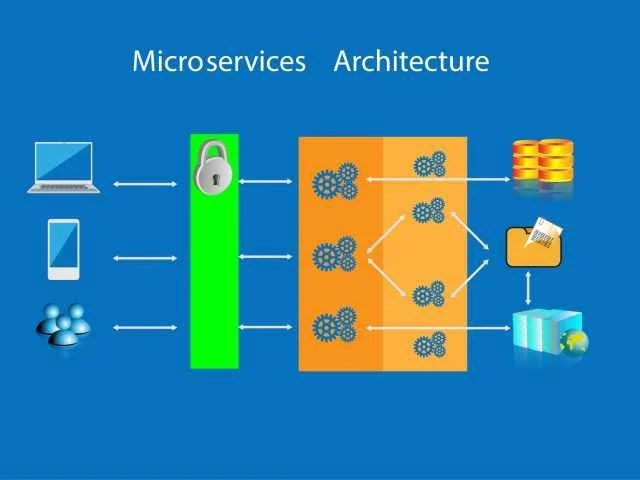
A microservices architecture without independent deployment pipelines per service is just a monolith split into more files. If shipping a change to your services still requires coordinating a release with four other teams, you’ve separated the code, not the work.
Each service should have its own container, CI/CD pipeline, and release cadence. Coordinating a shared deploy calendar across services defeats the purpose of decoupling them. Your team should be able to ship a fix to their service the moment it’s ready, without waiting for an unrelated service’s release window.
Container orchestration (whether that’s Kubernetes directly or a managed alternative like Google Cloud Run or Azure Container Apps) handles scaling, healing, and scheduling so that operational logic doesn’t have to be built and maintained by hand for every service. Building this in from the start is considerably easier than retrofitting it once a dozen services are already running without it.
Health check endpoints, like a simple /health route, let the orchestration platform route traffic around a failing instance automatically. Without one, the first sign of trouble is often a person noticing degraded performance rather than the system already having rerouted around it.
The practical difference shows up at release time. A deployment that requires syncing four teams’ calendars, running a shared regression suite across all of them, and hoping nothing breaks is what independent services were supposed to eliminate. Independent deployability should be where your team ships, tests, and rolls back their own service without touching anyone else’s pipeline.
If setting up these pipelines from scratch is the bottleneck, Eastgate’s product engineering team implements the container orchestration, CI/CD automation, and infrastructure-as-code setup that make per-service deployment repeatable across every service.
8. Secure every service-to-service call, not just the front door

More services mean more network boundaries. Every one of them is a place where credentials or data can leak. Perimeter security alone doesn’t cover the traffic moving between services once a request is already inside your system.
Service-to-service calls need their own authentication, typically through mutual TLS or a service identity system. Then you add on whatever authenticates the end user at the gateway. Without it, any service that gains network access to another can call it directly, whether that call should be allowed or not.
Secrets management needs to be centralized rather than scattered across each service’s configuration. Hardcoded credentials or API keys sitting in a service’s config file are one of the most common ways this goes wrong. Tools like HashiCorp Vault or a cloud provider’s secrets manager remove the need for any individual service to store sensitive values directly.
Least privilege applies per service, not just per user. Each service should only be able to call the specific other services and access only the specific data. A notification service that queries the payments database has more access than its function justifies. This gap is exactly what an attacker who compromises one service is looking for.
In regulated environments, this stops being a best practice and starts being a compliance requirement, with access control that has to be provable during an audit, not just present in principle. At any scale, microservices security best practices come down to the same three things:
- Least privilege per service
- Centralized secrets management
- Authenticated calls at every internal hop
9. Keep local development from becoming a distributed monolith

If your developers can’t run and debug one service locally without standing up the entire dependency graph, your architecture has already failed at independent deployability. It tends to surface on day one of local development, long before it appears in production logs.
Running every dependency locally to work on one service is impractical for most systems past a handful of services. The fix is to treat your consuming teams as if they were external API customers. They have to publish sample data and a realistic mock, so another team can stub your service instead of running a live copy of it.
Dependency injection makes this workable in practice. Swapping a real service call for a static, contract-shaped response inside a local environment is genuine engineering work. But it’s far less costly than maintaining a shared infrastructure state that every developer’s machine depends on staying in sync.
If your team can only catch most breaking changes during integration testing, rather than locally, that’s a sign your service boundaries and contracts are already too loosely enforced.
Local Kubernetes tooling, such as kind, Minikube, Skaffold, or Tilt, makes it easier to run services locally. But it doesn’t solve the stubbing problem on its own. These tools reduce the friction of running containers locally. They don’t reduce the number of services that must be running for a developer to make progress on a single feature. That distinction matters because teams sometimes reach for more local infrastructure when what they need is better contracts between services.
10. Sequence the migration: Decide what not to decouple yet
The nine microservices best practices above are all correct in isolation and dangerous when applied all at once. The highest-leverage decision in a real monolith-to-microservices migration isn’t which pattern to implement first. It’s about which capabilities to leave inside the monolith for now, and for how long.
Start with the capability under the most pressure, not the easiest to extract
Start by decoupling the capability that changes most often or needs to scale independently of everything else, not the one that happens to be easiest to extract. The easiest service to pull out is rarely the one causing the most pain. Prioritizing ease of extraction over actual need tends to produce a migration that looks like progress without addressing the bottleneck behind it.
Use the strangler fig pattern to de-risk boundary mistakes
The strangler fig approach reduces the risk of getting a boundary wrong. Route a portion of traffic to a new service while the old monolith code path still exists as a fallback. Only remove the old path once the new service has proven itself under real load. Getting a service boundary wrong is much cheaper to fix when the previous implementation is still there to fall back on.
Treat shared-database-with-schema-separation as a valid transitional state
A shared database with strict schema-level separation is a legitimate transitional state, not a failure of the migration. Database-per-service is the destination, not a day-one requirement. If your team treats it as non-negotiable from the start, you’ll often spend months on data separation work before shipping a single independently deployable service.
Budget time to re-split once real traffic patterns emerge
Boundaries drawn early will be wrong in places. Budgeting time to re-split or merge services once real traffic patterns are visible isn’t a sign the initial design was bad. It’s what a migration that’s paying attention to real usage looks like.
This is close to how sequencing decisions played out on a retail platform migration from a monolith to microservices, with zero impact to customers throughout the transition. The services that moved first were the ones under the most scaling pressure, not the ones that were simplest to pull out of the existing codebase. The parts of the system under less pressure stayed inside the monolith until there was a clear reason to move them.
11. Know when microservices are the wrong call in the first place
Every practice above assumes microservices are the right architecture for your system. That’s not always true. Getting this decision wrong upstream makes every downstream practice a waste of your engineering effort, regardless of how well it’s executed.
Three situations where microservices are not suitable include:
- Small applications. The scaling or team-coordination pressure that justifies a distributed system usually isn’t there yet. A monolith is faster to build, debug, and ship.
- Teams without prior distributed-systems experience. The learning curve compounds with every service added, often before the first service has even reached production.
- Domains that are still unclear or actively changing. Service boundaries are hard to draw with any confidence when the underlying business model hasn’t stabilized yet.
None of these situations is permanent. A small application can outgrow its monolith, and then your team can build the experience it’s missing. A domain can stabilize enough to support clear service boundaries later. The decision isn’t a permanent no. It’s not yet, with specific conditions to watch for.
Read the full breakdown of when not to use microservices for the complete decision framework if the microservices vs. monolith call hasn’t been made yet.
12. Adjust every practice for regulated or mission-critical systems

Every microservice best practice above gets stricter, not different, once your system is mission-critical. The margin for getting resilience, security, or observability wrong drops close to zero.
Uptime requirements change the resilience conversation from a nice-to-have into a contractual obligation. Circuit breakers, health checks, and failover aren’t hardening measures added after launch. They’re the baseline your system has to meet before it goes into production. It’s the same baseline a live transportation network is held to every day, not just during a launch window.
Compliance frameworks add specific, auditable requirements on top of general security practices. PCI-DSS covers payment processing. IEC 62443 covers industrial and transportation control systems. Both require that your logging, access control, and service-to-service authentication are provable during an audit. That’s a higher bar than general security practice. It changes how observability and access control get built from the start instead of retrofitted later.
Real-time systems, including traffic signal control and transaction processing, have latency budgets. They rule out some otherwise-reasonable async patterns on the control path, even when those same patterns are the right call elsewhere in the same system. A pattern that’s appropriate for updating an analytics dashboard a few seconds late is not appropriate for a control loop that has to respond within a fixed, short window.
Eastgate Software’s Siemens Mobility partnership, now more than twelve years old, is where most of these practices get tested against conditions a typical SaaS deployment never encounters. The practices themselves don’t change in regulated, real-time, or mission-critical contexts. What changes is how much room there is to implement any of them halfway.
Final thoughts
If you’ve made it this far, you already know the foundational practices. Service boundaries, data isolation, an API gateway, deliberate communication patterns, resilience mechanisms, centralized observability, independent deployment pipelines, security at every internal call. However, that’s not what this list was really about.
What decides whether your migration survives production is the judgment layered on top. Keeping local development workable as your system grows, sequencing which capabilities to decouple and when, recognizing when microservices aren’t the right call, and tightening every practice to near-zero tolerance in regulated or mission-critical systems. That’s where the real work is.
Before starting your next service split, write down which of these practices are deliberately not in place yet, and why. That list is a more honest indicator of migration readiness than the list of practices already checked off.